
Ageing Pipes and Health Risks: What Ontario Homeowners Should Know
How Ageing Plumbing Systems Can Affect Your Health In Ontario: Ageing Pipes and Health Risk
Quick note before we get into it: this one’s specifically about sewer pipes, the line that carries wastewater out of your house, not the pipes bringing drinking water in. We do sewer repair and sewer relining, so that’s the system we know inside out, and it’s also the system most Ontario homeowners never think about until it backs up into a basement. Ageing pipes and health risk go together more than people assume, and for sewer lines specifically, that risk builds slowly, underground, for decades before anyone notices.

What Kind Of Sewer Pipe Is Actually Under Your Yard
Depends entirely on when the house went in. Ontario’s older neighbourhoods have been built and rebuilt across more than a century of sewer materials, and each one comes with its own failure point.
Vitrified clay (terracotta) was the standard for sewer laterals right up through the 1960s and 70s, and a huge share of it is still down there in older Toronto and GTA neighbourhoods. Clay itself doesn’t corrode, which is its one real strength, but the pipe sections are joined every few feet, and those joints shift as the ground around them settles or freezes and thaws. Once a joint opens even slightly, you’ve got an entry point.
Orangeburg pipe — wood pulp bonded with coal-tar pitch, had a good run from the 1940s through the late 1960s because it was cheap and easy to install. It was marketed as a 50-year pipe. In practice, a lot of it has failed in ten to twenty. The material softens with constant moisture and gradually deforms into an oval, which chokes off flow long before the pipe actually collapses.
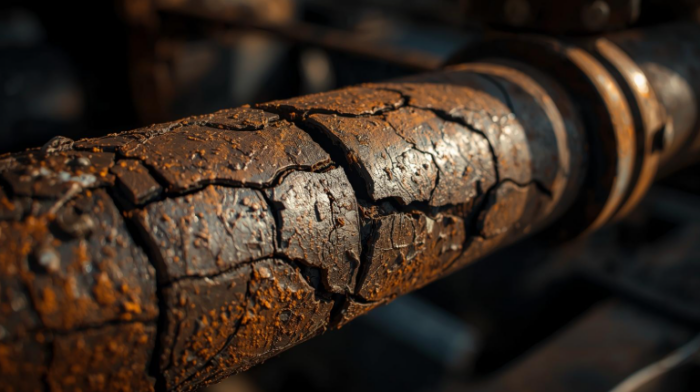
Cast iron shows up mostly on the interior drainage side and in some older laterals. It’s tough structurally, but it corrodes from the inside, and decades of that corrosion roughens the interior wall and narrows the pipe’s diameter.
Concrete pipe was used for some municipal sewer mains and larger laterals mid-century. It holds up structurally but is vulnerable to corrosion from hydrogen sulphide gas, which converts to sulphuric acid on the pipe’s inner surface over time.
PVC and ABS are what’s used today, and for good reason: they don’t corrode, the joints are solvent-welded rather than mechanically fitted, and they’ve got real flexibility. Nothing lasts forever, but this is the first sewer material that doesn’t have an obvious weak point baked into the design.
How These Pipes Actually Fail
Clay cracks at the joint. Orangeburg deforms. Cast iron corrodes and narrows. Different mechanisms, same outcome: an opening in a pipe that’s supposed to be sealed.
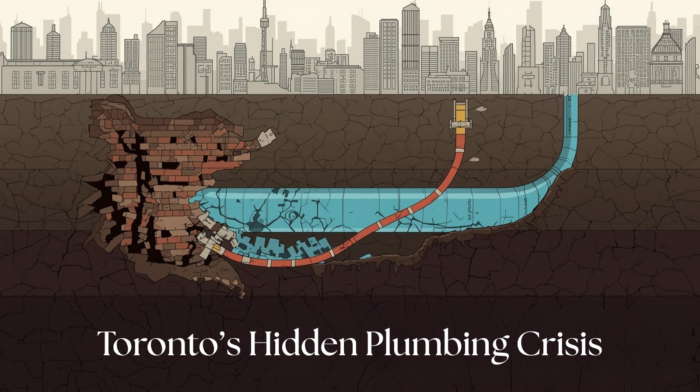
Once that happens, the pipe starts doing two things it shouldn’t. Wastewater can exfiltrate out through the crack into the surrounding soil, and groundwater can infiltrate in, which adds strain to the whole system and, during a heavy rain, can be enough to push a backup up into your basement. Neither direction is good. Sewage in the soil around your foundation is a bacterial and odour problem. Groundwater flooding into an already-compromised pipe accelerates whatever damage caused the crack in the first place.
The Actual Health Risk
A cracked sewer line doesn’t sit there quietly. Peer-reviewed research on urban sewer leakage has found that leaking sewers measurably raise bacterial indicator levels in nearby groundwater, and where that groundwater is close enough to a water supply, the same contamination pathway applies. In practice, most Ontario homes aren’t drawing well water next to a leaking sewer lateral. But older properties where a sewer line and an ageing water service line run through the same trench are exactly the setup where a problem on one side can start affecting the other, especially once both lines are decades past their design life.
Inside the house, the risks are more direct. A slow leak or a partial blockage lets sewer gas, hydrogen sulphide and methane, work its way up through floor drains and traps, which at low levels causes headaches and nausea and gets blamed on everything except the actual source. A backup that reaches a finished basement leaves behind moisture that mould takes hold of within days, and once that starts, you’re dealing with a respiratory issue on top of a plumbing one. None of this shows up on a water bill. It shows up as a smell nobody can place, or a family that keeps getting sick for no clear reason.
Tree Roots Don’t Start The Problem, But They Finish It
Worth clearing up a common misconception: tree roots don’t crack sewer pipes. They can’t. What they do is find a crack or an open joint that’s already there, drawn in by the water vapour escaping from warm wastewater into cold soil, and once a root gets a foothold, it thickens inside the pipe and turns a hairline crack into a full blockage or a collapse. This is where an already-degraded sewer line and a nearby ageing water line can end up sharing a problem: the same soil movement and root activity that opened the sewer joint is often stressing whatever else is running through that same patch of ground.
And Then It Shows Up In Your Drains
Your interior drains, kitchen sink, tub, floor drain, all tie into the same sewer lateral running out to the street. So a partial blockage forty feet under your yard doesn’t stay there. It shows up as a slow tub drain, gurgling when the washing machine empties, or a floor drain backing up during a storm. Most homeowners chase the symptom, snaking a drain that clears for a week and clogs again, without realizing the real problem is underground where the snake never reaches.
Why Routine Inspection Actually Matters
Every material above fails slowly, which is the good news. A hairline crack or a slightly open joint doesn’t need a full pipe replacement. It needs to be found early. A camera inspection run through the line shows exactly where a joint has opened, where roots have gotten in, or where a section of Orangeburg has started to flatten, while it’s still a small, fixable problem instead of a collapsed pipe and a torn-up yard. Getting a lateral scoped every few years, or any time a home changes hands, is genuinely one of the cheapest ways to add another five or ten years to a pipe that’s already decades old.
What Relining Actually Fixes
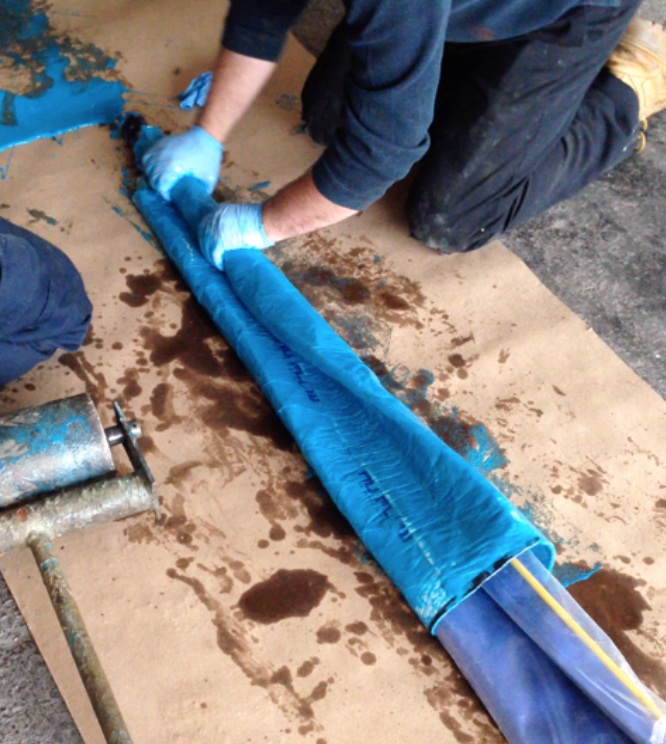
Once an inspection turns up damage, trenchless sewer repair is usually the better option over digging up the yard. A resin-saturated liner goes in through the existing access point, gets inflated against the old pipe’s walls, and cures in place, forming a smooth new pipe inside the damaged one. It works on clay, cast iron, and Orangeburg alike, and it seals off every joint and crack that was letting roots and groundwater in. It’s become the standard approach for sewer repair in Toronto homes running on original clay or Orangeburg lines, and every relining job we do starts with the same sewer camera inspection that catches the problem in the first place.
The Bottom Line
Sewer pipes are the part of the house nobody thinks about, right up until they back up. If your home’s running on original clay, Orangeburg, or ageing cast iron, a camera inspection is the fastest way to find out how much life is actually left in it, and whether relining now saves you a much bigger dig later.
Frequently Asked Questions On Ageing Sewer Pipes In Ontario
1. How do I know what kind of sewer pipe my house has?
Age is the first clue, pre-1970 usually means clay, sometimes Orangeburg, but the only way to know for sure is a camera inspection down the actual line.
2. Is Orangeburg pipe really that bad?
If your home still has it, yes, it’s worth prioritizing. Most Orangeburg installed in the 1950s and 60s is already past or near the end of its usable life, and it fails by deforming rather than cracking, so it’s often worse than it looks from the surface.
3. Can a damaged sewer line really affect my drinking water?
Not directly in most homes, since supply lines are pressurized and sewer lines aren’t. But where an old water line and a leaking sewer line share a trench, which is common in older Ontario properties, contamination in the soil around both is a documented risk.
4. How often should I get my sewer line inspected?
Every few years for an older home is reasonable, and definitely before buying a pre-1980s property. It’s a lot cheaper than finding out about a collapsed line during a backup.
5. Does relining actually last as long as a full pipe replacement?
Modern CIPP liners are typically rated for 50 or more years, which puts them in the same range as a full replacement, without the excavation.