Your basement drain is gurgling, the toilet won’t flush properly, and a plumber just told you there’s a problem “somewhere out front.” The next question is always the same one: who pays for sewer line repair in Toronto, you or the City?
The answer depends on one invisible line in your front yard. Get it wrong and you could pay for work the City should have done, or wait weeks for the City to fix something that was yours all along.

The Short Answer: Who Pays for Sewer Line Repair in Toronto?
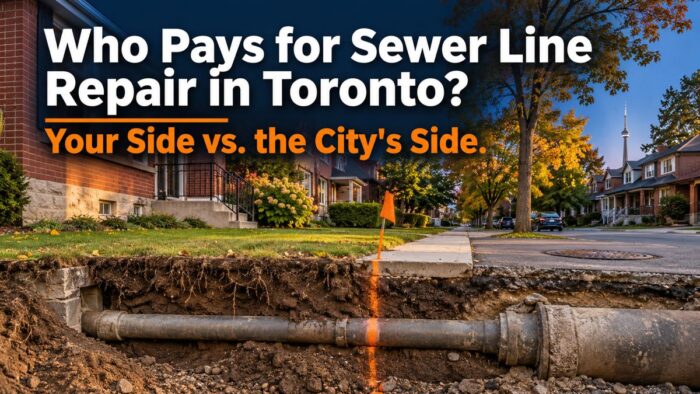
The pipe that carries wastewater from your house to the street is split in two at your property line. The City of Toronto
owns the section from the sewer main under the street to the property line. You own everything from the property line into your home.
So the rule is simple:
Problem on the City side? The City investigates and repairs it.
Problem on your side? You hire a licensed contractor and you pay, sometimes with help from insurance.
The tricky part is proving which side the problem is on. That’s what the rest of this guide is about.
What Is a Sewer Lateral (Sewer Service Connection)?
A sewer lateral is the single underground pipe that connects your home’s plumbing to the public sewer main. Plumbers call it a lateral. The City calls it a sewer service connection or sewer service line. Same pipe.
Toronto has a lot of them. The City manages
nearly 3,800 km of sanitary sewers and more than 523,000 City-owned sewer service line connections. Each one is half public, half private.
A typical lateral in an older Toronto home looks like this, from the house outward:
Inside the basement: the main stack, floor drain and a cleanout (if you’re lucky enough to have one).
Under your front yard: the private section, often clay or cast iron in pre-1970s homes.
At the property line: the ownership switch. Sometimes there’s an outdoor cleanout here; often there isn’t.
Under the boulevard and road: the City section, running to the main.
One wrinkle worth knowing: not every house has its own lateral. Some older homes share a “Y” connection, and in parts of the inner suburbs a private pipe crosses a neighbour’s lot before reaching the City line. The City calls these party lines and notes that
problems with them are generally outside the City’s responsibility. If neighbours on your street flood at the same time as you, ask your plumber to check for a shared line.
If you already know your lateral is cracked or collapsing on the private side, our page on
sewer lateral repair in Toronto explains the options.
Where Your Side Ends and the City’s Side Begins
Your responsibility ends at the property line. In Toronto’s words, the
City-side connects to the sanitary sewer under the street and the private-side connects to your property, with the split at that line.
Here’s the catch most homeowners miss.
Your property line is usually not your sidewalk or curb. In many Toronto neighbourhoods the City owns a strip of grass (the boulevard) between the sidewalk and your lawn. Your survey or the City’s property maps will show where the line actually sits.
|
City side |
Private side (yours) |
| Runs from |
Sewer main under the street |
Property line |
| Runs to |
Property line |
Inside your home |
| Who owns it |
City of Toronto |
Homeowner |
| Who fixes it |
Toronto Water crews |
A licensed contractor you hire |
| Who pays |
City |
Homeowner (insurance may help) |
| Typical problems |
Main blockages, collapses under the road, roots in the City section |
Cracked clay or cast iron, root intrusion, bellies, grease buildup, collapsed pipe under the lawn |
The City is also clear that it
does not replace or install sewer service connections on private property. That’s on the owner, no matter how old the pipe is.
Is the City responsible for my sewer line, then? Only for the part outside your lot. If your problem is a single slow sink, it’s almost certainly inside the house. If every fixture backs up at once, or you’ve noticed the
signs you need sewer repair like sewage odours and recurring clogs, the issue is in the lateral and could be on either side.
What If City Tree Roots Damage Your Sewer Line?
This is where most disputes start. A big City-owned maple sits on the boulevard, its roots end up in your pipe, and you assume the City pays. Not necessarily.
Roots in the City section. Toronto’s long-standing policy is that drains within City property are repaired by the City at no cost to the owner,
whether the roots come from a city tree or a private one.
City roots in your section. This one is harder. When a Toronto family blamed a City-owned Norway maple for a broken pipe in 2018, Toronto Water’s director said the damaged section was past the property line, so
the city would not replace it. He also pointed out that roots often find a crack that was already leaking rather than causing it.
That matches what we see on camera. Roots rarely break a sound pipe. They find a loose clay joint or hairline crack, follow the moisture in, and grow until the line plugs.
The City did run a drain grant for private drains blocked by City tree roots, verified by City staff, under a 1999 policy. Whether any version of that help still applies to your case is a question for 311, so ask when you report the problem. Otherwise your route is a third-party claim, covered below.
Either way, clearing roots only buys time. Our guide to
tree roots in your sewer line covers why they keep coming back and what actually stops them.
How to Report a Sewer Problem to the City of Toronto
Call 311 or
submit a service request online before you hire anyone. Sewer line blockages are Toronto Water’s busiest call type, with
7,626 requests in 2023, so the process is well worn.
Here’s how it plays out, according to
Toronto Water’s own process:
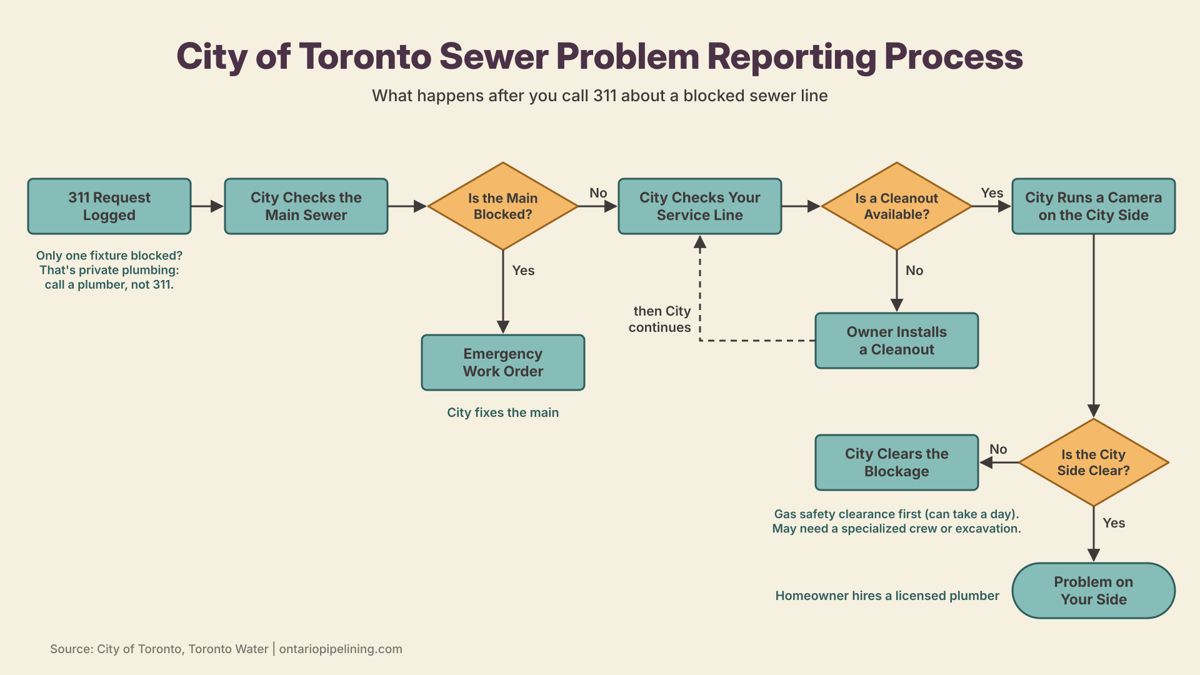
Request logged. Staff aim to investigate within four hours, but heavy storms can delay that. Someone has to be home to let them in.
Main sewer checked. If the main under the street is blocked, the City opens an emergency work order and tells you the schedule.
Your lateral checked. If the main is fine, the technician inspects your line through a cleanout. No working cleanout? You’ll be told to have one installed first, usually by a licensed plumber.
City side scoped. Depending on where the cleanout is, the technician runs a CCTV camera through the City section. If it’s clear, the problem is on your side.
City-side blockage cleared. A natural gas sewer safety inspection comes first, then snaking or plunging. If that fails, a specialized crew may dig. Repairs can take hours or up to two days.
Don’t skip that 311 call even if you’re sure the problem is yours. The City keeps an inspection record of every report, and that record plays a role if you ever file a claim.
Will the City Inspect Before You Hire a Contractor?
Yes, and you should let it. Toronto Water’s investigation is the quickest way to learn whether the City side is part of the problem. If the City finds a blockage in its section, it clears or repairs it. If the City side is clear, the technician will tell you the issue is on your side and advise you to call a licensed plumber.
The one thing that can stall this: no accessible cleanout. The City needs a way into your line. If you don’t have one, installing a cleanout is your cost, and it’s worth doing anyway because every future inspection gets cheaper and faster.
Can a Camera Inspection Prove the Problem Is on the City’s Side?
It’s the best evidence you can get. A private
sewer camera inspection records the inside of your lateral from the cleanout to the main, with a running distance counter on screen. A locator on the camera head lets the technician mark the exact spot of a crack or root mass on the ground above it.
Compare that mark with your property line and the question usually answers itself. A few tips to make the footage count:
Ask for the video file, not just a summary. Toronto Water staff and insurance adjusters will want to see it.
Get the distance to the defect measured from a fixed point like the foundation wall or cleanout.
Have the defect located and marked on the surface, then photograph the mark beside the curb or sidewalk.
Share it with the 311 technician when they visit. The City still runs its own CCTV on its section and makes its own call, but clear footage speeds things up.
If the camera shows the damage is on your side, our team handles
drain repair in Toronto from minor root cutting to full lining.
Does Home Insurance Cover Your Side of the Sewer Line?
Usually not the pipe itself, at least not on a standard policy. Insurers treat a cracked or root-filled lateral as wear and tear, which is a maintenance cost.
Two optional add-ons change that picture, and they cover different things:
| Endorsement |
What it pays for |
What it doesn’t |
| Sewer backup |
Water and sewage damage inside your home after a backup (flooring, drywall, contents) |
Repairing the broken pipe outside |
| Service line |
Digging up, repairing or replacing the underground line on your property, up to a set limit |
Damage from long-term neglect; limits vary by insurer |
The Insurance Bureau of Canada is blunt about the first one: basement damage from a sewer backup is
only covered if you bought the specific optional coverage. Pull out your policy and look for “sewer backup” and “service line” by name before you need them.
What about suing the City? If City-side neglect caused your damage, you can file a
third-party liability claim against the City. Be realistic, though. The City only pays when you can prove its negligence, and an Ombudsman review found the City
denied 1,130 of 1,461 basement flooding and sewer backup claims filed between 2015 and 2019. Your own insurance is normally the faster route. Your 311 report and camera footage are what give any claim a fighting chance.
Are There Rebates for Sewer Repairs in Toronto?
Not for repairing the lateral itself. Toronto’s main homeowner program is the
Basement Flooding Protection Subsidy Program, and it pays for flood-protection devices, not pipe repair or relining.
It is still worth knowing, because it was expanded on May 1, 2026 to up to $6,650 per property. For eligible work completed on or after November 12, 2025, it covers 80% of the invoiced cost up to these limits:
| Eligible work |
Maximum subsidy |
| Sump pump with alarm |
$2,250 |
| Backwater valve with alarm (up to two) |
$1,600 each |
| Home plumbing assessment by a licensed plumber |
$500 |
| External weeping tile severance and capping |
$400 |
| Sump pump battery backup |
$300 |
It’s open to owners of single-family homes, duplexes, triplexes and fourplexes in Toronto. Backwater valves need a building permit and City inspection, and you have up to two years after installation to apply.
If your lateral is being repaired anyway, that’s a smart time to add a backwater valve, since the line is already being accessed. Outside Toronto, several Ontario municipalities do offer lateral repair rebates; see our roundup of
sewer rebates available in Ontario.
Can Trenchless Lining Fix Your Side Without Digging Up the Boulevard?
In most cases, yes. With cured-in-place pipe (CIPP) lining, a resin-soaked liner is pulled into your existing pipe through the cleanout and cured in place. It forms a new, jointless pipe inside the old one, which seals the cracks and loose joints roots love.
For a private-side repair, that means:
No trench across your lawn, driveway or garden. Access is through the cleanout.
The work stops at your property line. The City’s boulevard and road are never touched, because that section isn’t yours to repair.
Usually done in a day for a typical residential lateral, with water service back the same day.
What if the City side is damaged too? That part stays the City’s job. You can’t hire a contractor to line the City section yourself. The good news is that Toronto Water uses the same technology on its own connections; the City has a published spec for
cured-in-place lining of sewer service connections from the main up to the property line.
Not every pipe can be lined. A fully collapsed section or a badly sagging belly may need a spot excavation first, and a camera inspection is the only honest way to know. For budgeting, our breakdown of
trenchless sewer repair cost covers what drives the price up or down.
Find Out Which Side the Problem Is On
So, who pays for sewer line repair in Toronto? The City pays for its side, you pay for yours, and the property line decides which is which. The fastest path to a fair answer is simple: call 311 first, get a camera inspection with footage you can keep, and only then decide on a repair.
When the problem turns out to be on your side, Ontario Pipe Lining can line your lateral from the cleanout to the property line without trenching your yard. Book a camera inspection or ask about
sewer repair in Toronto and we’ll show you exactly what’s going on underground, and whose problem it is.
Frequently Asked Questions
1. Who is responsible for the sewer line between my house and the street in Toronto?
It’s shared. The City of Toronto owns and maintains the section from the sewer main under the street to your property line. You own and maintain everything from the property line into your home, including repairs and replacement.
2. Where does my responsibility end and the City’s begin?
At your property line, which is often a few metres back from the curb or sidewalk rather than at it. The grass boulevard in front of many Toronto homes belongs to the City. Check your property survey if you’re unsure.
3. What is a sewer lateral (sewer service connection)?
It’s the underground pipe that carries wastewater from your home to the City’s sewer main. “Sewer lateral” is the trade term; the City calls it a sewer service connection or service line. In Toronto, each one is part private and part City-owned.
4. What happens if City tree roots damage my sewer line?
If the roots are in the City section, the City clears and repairs it. If they’ve damaged your section, the City’s position is that it won’t replace private pipes. Ask 311 whether any assistance applies, and talk to your insurer about a claim.
5. How do I report a sewer problem to the City of Toronto?
Call 311 or submit a service request online. Toronto Water aims to investigate within four hours, longer during storms, and someone needs to be home. Have your cleanout cleared and accessible so the technician can get into the line.
6. Will the City inspect my sewer line before I hire a contractor?
Yes. After a 311 report, Toronto Water checks the main sewer, then inspects your line through a cleanout and may run a camera through the City section. If the City side is clear, they’ll tell you the problem is yours to fix.
7. Can I get a camera inspection to prove the problem is on the City’s side?
Yes. A private sewer camera inspection records the full lateral with distance markings, and a locator pinpoints defects on the ground. Footage showing damage past your property line is strong evidence to share with the 311 technician, though the City makes its own call.
8. Does home insurance cover the private portion of my sewer line?
Standard policies usually don’t cover a worn or root-damaged pipe. A service line endorsement can cover repair or replacement of underground lines on your property, and a sewer backup endorsement covers damage inside the home. Check your policy for both by name.
9. Are there rebates or subsidies for sewer repairs in Toronto?
Not for lateral repair. Toronto’s Basement Flooding Protection Subsidy Program pays up to $6,650 per property toward backwater valves, sump pumps, plumbing assessments and weeping tile disconnection. Some other Ontario municipalities do offer lateral repair rebates.
10. Can trenchless lining fix my side without digging up the City’s boulevard?
Usually, yes. CIPP lining goes in through your cleanout and creates a new pipe inside the old one, stopping at your property line. The boulevard stays untouched. A camera inspection first confirms whether your pipe is a good candidate.